
On discomfort, deconstruction, and the freedom to imagine a God who is more
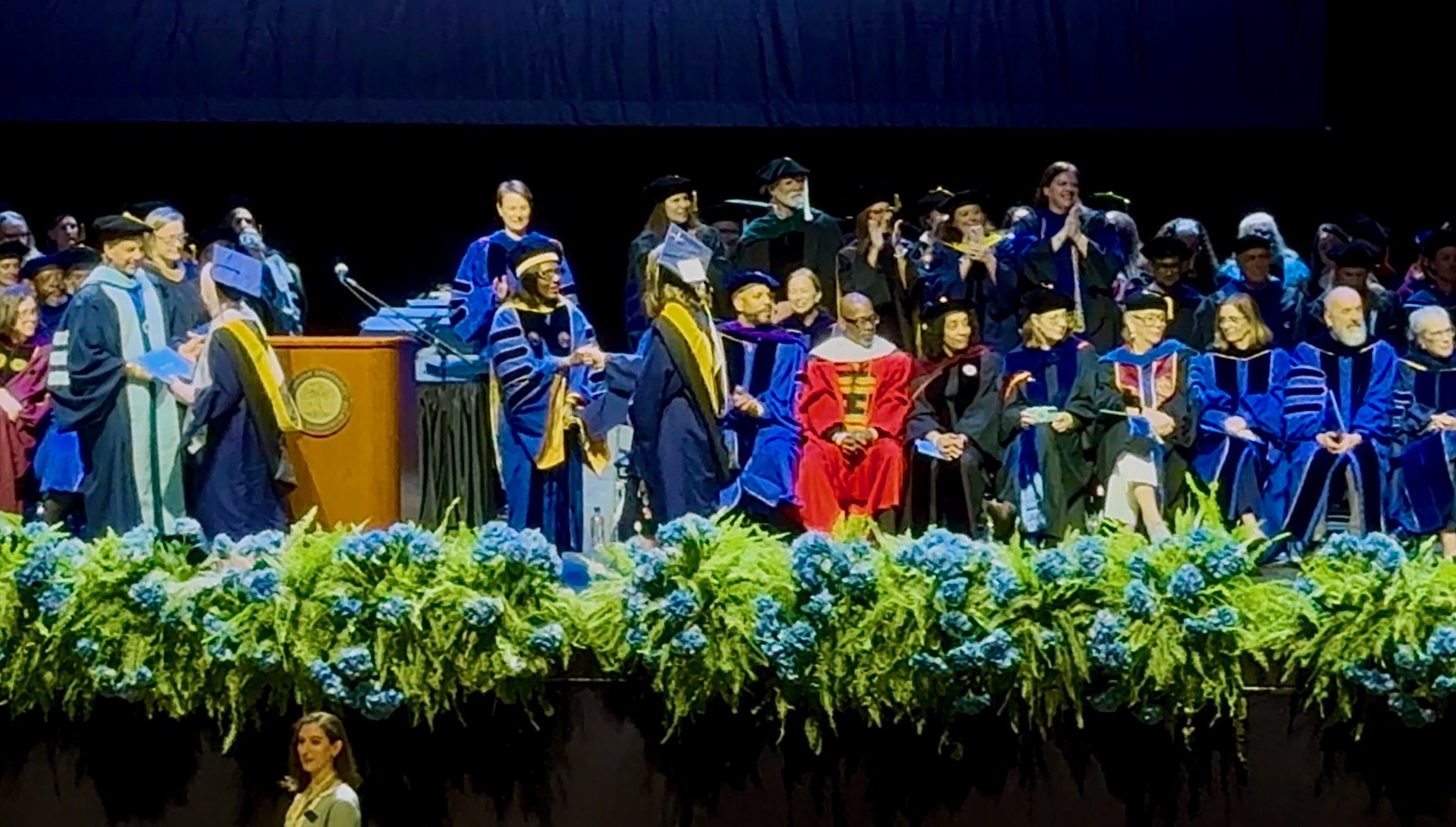
The Boston air was crisp, the atmosphere full of excitement as we made our way to our seats. The dimly lit MGM Music Hall, a space designed for concerts and performances, was transformed into a place of academic tradition. Simmons blue filled the stadium, from the lights that lined the balconies and the beautiful curtains that graced the stage, forming the perfect backdrop for this sacred day, to the sea of blue caps and gowns that gradually filled the floor below as the processional began.
As I watched my daughter enter the arena, adorned in her master’s regalia, I was overcome with the emotions of the day, recalling the years of challenging work, the countless tears she shed as she tried to balance school, work, trauma healing, and shifting beliefs.
As the room settled into a collective stillness, the first speaker stepped to the podium and opened with a prayer addressed to “the Creator and mother of us all.”
The prayer struck me in a way I never expected.
It has taken me years to get to this point, and although I felt that old, familiar flicker of discomfort – the one I’ve spent years unlearning – the reflex felt more like muscle memory than belief. Where once I would have been offended – outraged even – I now found myself in complete agreement with the speaker’s brief description of God as mother.
Yet, it bothered me that even after years of deconstruction, healing, and reshaping my faith, I still feel that tiny internal jolt when someone refers to God as Mother. It’s faint now, more like a whisper than a shout, but it’s still there. I’ve learned to treat that discomfort as evidence of my own deep indoctrination rather than a confirmation of theological error.
Like so many others, I was raised in a religious world where God was always He. Always Father. Always male. Not metaphorically male, but functionally, structurally, unquestioningly male. The men who shaped the theology I inherited – pastors, authors, seminary professors, and church fathers – looked like God in the stories they told. Or rather, they made God look like themselves.
And I, like everyone else in that world, absorbed it, internalized it, and allowed it to become part of me – a core doctrine that, if challenged, meant you were rejecting God.
We were taught to see God through a single, narrow lens, and to believe that lens was the whole picture. We were programmed to notice the masculine metaphors in scripture and to overlook the feminine ones. We were conditioned to believe that calling God “Mother” was heretical, pagan, dangerous, possibly even idol worship.
But eventually I began to use critical thinking, to listen to voices outside of my small, close-minded world instead of staying inside that cursed echo chamber, and to recognize that none of that discomfort actually came from God.
It came from the system the Bible repeatedly subverts – patriarchy.
It came from a system built by men, for men, to reinforce the authority of men. A system where the alleged manhood of God has been used for millennia as a theological weapon. A system that has long proclaimed, “Men are closer to God. Men reflect God more accurately. Men are designed to lead because God is a man.”
Except… God isn’t a man.
God isn’t a woman either.
God isn’t a biological organism with a body, chromosomes, or reproductive organs. God doesn’t have a beard or a womb. God doesn’t have testosterone or estrogen. God doesn’t fit into the categories that define human gender or biological sex. The divine nature of God is so far beyond every human category that our human minds can never fully comprehend it.
To insist that God is only male is to shrink the divine down to the size of our own cultural imagination. It is to create God in our image, something scripture explicitly warns against.
The Bible itself is full of feminine and motherly imagery for God. We just weren’t taught to see it. We weren’t taught to notice God laboring like a woman in childbirth, or nursing her children, or comforting like a mother, or gathering her people like a mother hen. Those passages were there all along, but our theological training had a built-in filter.
We learned to see only what upheld the system.
We learned to ignore what challenged it.
So, when someone calls God “Mother,” the discomfort we feel is cultural, not spiritual – the effects of indoctrination, not the conviction of the Holy Spirit. That discomfort is the reverberation of a patriarchal system that taught us to equate masculinity with holiness and femininity with danger.
My beliefs have changed significantly over the years. I still believe in God. I still deeply love and follow Jesus. But I no longer believe in a God who fits neatly into the simplistic gender roles of ancient patriarchal societies. I no longer believe that God’s identity is limited to the metaphors preferred by men who lived thousands of years ago, or those who live down the street and preach messages that look nothing like the love Jesus modeled.
Now, when I hear someone call God “Mother,” I feel something different rising beneath the old discomfort: freedom.
Freedom to imagine a God who transcends gender.
Freedom to embrace the fullness of divine imagery.
Freedom to let God be bigger than the boxes we inherited.
The discomfort is fading, not because I have rejected God, but because I have stopped confusing God with the harmful system that claimed to speak for God while elevating the men who shaped it and silencing everyone else.
If anything, expanding my language for God has expanded my understanding of God. It has made God more mysterious, more beautiful, more expansive, more true.
When the speaker at my daughter’s graduation prayed to “the creator and mother of us all,” I felt that old tension rise, and then I felt it loosen because I now understand that it is patriarchy and not God that is offended by feminine language.
And I am no longer interested in protecting patriarchy.
I’m interested in knowing God.
A God who is beyond gender.
Beyond our categories.
Beyond our fear.
Beyond our discomfort.
Beyond anything our human minds can fully comprehend.
A God who is, in every sense, more.
Leave a Reply